
Six drivers. One supercycle.
Infrastructure
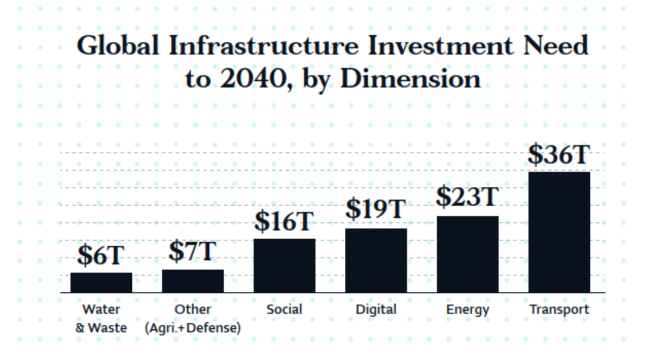
- The capital requirement is unprecedented. An estimated USD 106 trillion of global infrastructure investment is needed through 2040 to keep pace with demand, and private capital is called upon to close the gap.
- The underlying assets are changing. Digitalization, decarbonization, and deglobalization are driving the next generation of infrastructure assets, which sit at the intersection of energy, digital, transport, and social infrastructure. From an investor standpoint, this redefines how returns are generated, presenting new challenges and opportunities.
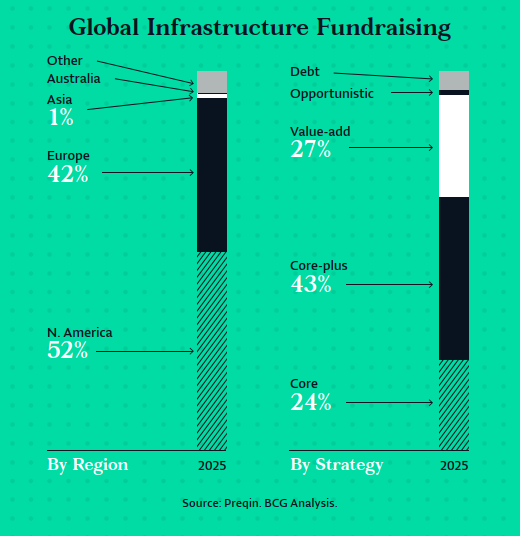
- The asset class has proven its character through a full cycle of inflation, rate shocks, and slower private-market fundraising. The 2025 fundraising of USD 211 billion set a new record — the strongest rebound of any private asset class.

What Makes Infrastructure Interesting Now
The next infrastructure cycle combines essential demand with digital growth, physical-asset exposure, and multiple avenues for value creation.
A USD 106 Trillion Investment Need Through 2040
McKinsey estimates USD 106 trillion of global infrastructure investment is needed through 2040. Transport and logistics require the largest share, followed by energy and power, digital, social, water and waste, agriculture, and defense. The scale of this requirement creates a long-term capital cycle across both established and next-generation assets.
Next-generation Assets Are Where Capital Is Going
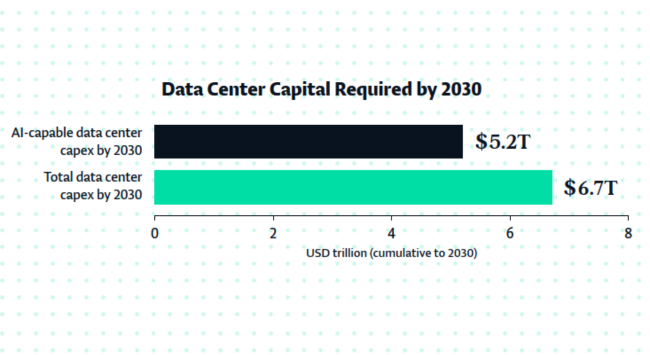
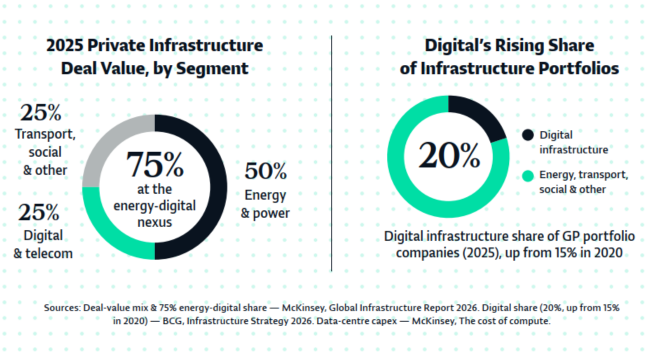
AI and cloud workloads are increasing demand for data centers, power generation, transmission, storage, and fiber networks. About 75% of infrastructure capital raised in 2023–2024 targeted opportunities at the intersection of digital, energy, social, and transport: data centers, EV charging, fiber, grid-edge power, and low-carbon fuels.
Manager Selection Matters as the Market Broadens
Infrastructure has emerged as a distinct allocation within the private markets spectrum, combining contracted cashflow visibility with capital appreciation through hard assets. Private wealth can now participate on institutional terms. Manager selection and access are increasingly the dominant drivers of portfolio outcomes.
Six Structural Drivers
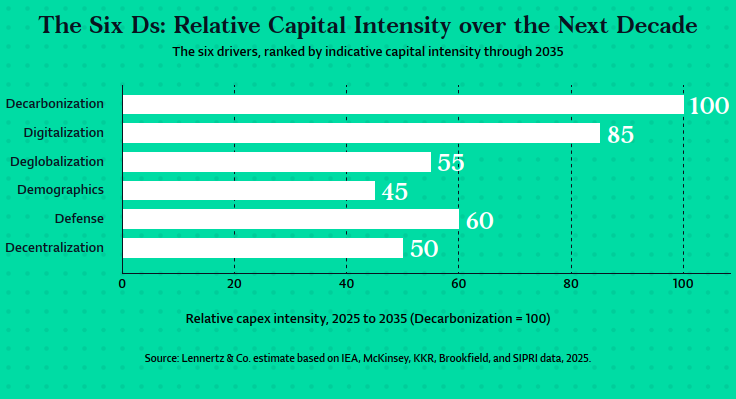
Infrastructure stands at the intersection of the greatest transformative powers of the 21st century. The rise of digital services and the AI boom create an unprecedented need for computing power, data centers, and energy.
The energy transition is driven by both limited carbon resources and geopolitical events worldwide that restrict distribution or raise fuel prices. Those geopolitical events also trigger massive investments in defense, a large part of which goes toward dual-use infrastructure.
Lastly, the need for supply chain resilience and reshoring of critical materials is resurfacing demand for less dependence on offshore providers and decentralization.
Where the Investment Opportunity Lives
- Infrastructure assets typically share four defining traits: long economic lives, high barriers to entry, contracted or regulated cash flows, and a degree of inflation linkage through tariffs or concession terms.
- Specialist GPs, focused on a single sub-sector such as digital infrastructure or renewables, tend to outperform generalist large-cap peers in their core area.
- The investable universe spans four risk-return strategies. Core and core-plus are appropriate for investors seeking duration and yield. Opportunistic is private-equity returns and risks. Value-add is where private-equity returns are achievable without abandoning the structural downside protection that makes infrastructure worth allocating in the first place.
What topics are covered in the whitepaper?
The whitepaper examines infrastructure’s five dimensions and the six structural drivers shaping demand. Topics include global capital needs, regional opportunities, investment vehicles, risk-return strategies, market performance, manager selection, and risks linked to inflation, regulation, climate stress, geopolitics, cybersecurity, and technology obsolescence.
Who should download this whitepaper?
The content is tailored for qualified investors, family offices, wealth managers, and decision-makers seeking in-depth, data-driven insights into the infrastructure opportunities across private markets.
How is the information in the whitepaper sourced and verified?
All research and analysis are based on reputable industry reports, regulatory disclosures, market data, and proprietary insights. The information is thoroughly reviewed and verified by experienced professionals in accordance with industry best practices.
This report is neither an offer nor a recommendation to buy or sell financial instruments or assets, or shares of a specific fund. The information contained herein is sourced from what we deem reliable and received in good faith. However, we do not assume any liability or provide a guarantee regarding the timeliness, accuracy, completeness, economic viability, or suitability for a particular purpose of the information contained in this document. The information in this report is based on the knowledge available at the time of the creation of this document. The information may be incomplete and subject to change.
Furthermore, the information and estimates contained herein do not serve the purpose of investment, legal, or tax advice. They do not replace individual investment advice. These are marketing materials, and therefore, the information is exclusively intended for informational purposes. All the information contained herein is to be treated confidentially and may not be disclosed, reproduced, or shared with third parties without prior approval. The product is exclusively aimed at professional and semi-professional investors as defined by the Capital Investment Code (KAGB) and is not intended for private investors.
This publication is protected by copyright. The use of citations or graphics is legally permissible with explicit reference to the external authorship (source reference in accordance with Section 63 of the German Copyright Act). Copyright violations will be prosecuted.
Is there a cost or registration required to access the whitepaper?
The whitepaper is available at no cost. Registration with valid contact information is required to access the download.
How will my contact information be used? (Data Privacy)
Your information will be used solely to fulfill your request and to provide relevant updates on investment opportunities. All data is handled in accordance with applicable data protection regulations and our firm's privacy policy.
Imprint
Information according to § 5 TMG:
Lennertz & Co. Capital GmbH
Düsternstraße 10
20355 Hamburg
Germany
Represented by:
Philipp Lennertz, Christian Piper
Contact:
Tel: +49 40 210 91 33-20
Email: info@lennertz.com
Register entry:
Office: Hamburg
Register number: HRB 176714
Supervisory authority:
Bundesanstalt für Finanzdienstleistungsaufsicht (Federal Financial Supervisory Authority)
Marie-Curie-Str. 24-28
60439 Frankfurt
Germany